King's X
The Blueprint of Modern Heavy


As Noise Protocol turns one, getting the chance to sit down with dUg Pinnick of King’s X feels like a gift. Few artists have influenced heavy music (or myself) as profoundly—or spoken about it with such honesty. Thank you to dUg for the music and conversation, and here’s to another year of Noise Protocol.
Being a band’s band cuts both ways. It means you’ve shaped the sound of everyone else, but never quite cashed the checks your influence deserves. For over four decades, bassist and vocalist Doug “dUg” Pinnick, guitarist Ty Tabor, and drummer Jerry Gaskill have crafted unique music that’s heavy and melodic, a harmonious fusion of metal, gospel, and soul that has influenced generations of musicians while eluding the commercial spotlight.
“All three of us were really particular about how we shook that string and our tone,” Pinnick said. “We’re tone freaks from hell.”
The unwavering belief that tone and honesty are the core of artistic identity underlies the entire King’s X legacy. They’ve become one of rock’s most quietly transformative bands, championed by peers like Pearl Jam and Soundgarden and foundational to countless musicians across heavy genres. Arguably, we wouldn’t have Deftones, Tool, or Sleep Token as we know them today if it were not for King’s X.
Beginnings in Missouri and Texas
The story starts in Springfield, Missouri, in the late 1970s, where Pinnick and Gaskill first crossed paths. They played covers around the Midwest under names like The Edge and Sneak Preview, honing a groove-heavy mix of classic rock, funk, and proto-prog.
By the early 1980s, guitarist Ty Tabor joined, and the chemistry locked. “All three of us listened to everything,” Pinnick said. “But we all listened to ‘70s rock. Even though I’m thirteen years older than Ty and Jerry’s seven years younger than me. We’re like three brothers who grew up in this same family listening to the same music.” That shared musical DNA proved to be an important part of what would become the King’s X sound. As dUg explained, “The thing about 70s music is there was lots of nuance in the instruments that people played back then. That’s why those bands have such a unique sound. And I think that’s a big thing that we had.”
That attention to detail became their foundation. They renamed themselves King’s X in 1985, eventually signing to Megaforce Records, making them labelmates to bands like Metallica and Anthrax. They released their debut Out of the Silent Planet in 1988, which established some hallmarks of the band’s sound like a tendency towards thick drop-D riffs, Beatles-esque harmonies, and spiritual introspection that didn’t sound like anything else on rock radio.
Follow-up release Gretchen Goes to Nebraska (1989) deepened the band’s palette with lush, layered instrumentation and philosophically curious themes, and would cement King’s X cult status as a visionary, innovative heavy act to keep your eyes on. “It’s one of those rare albums that feels like a best-of because every track is a highlight, and it hasn’t lost any of its relevancy or enjoyment since it came out,” noted music writer Jordan Blum.
The album was also a post-production outlier. While most of their contemporaries leaned into reverb-laden vocals and highly compressed, glossy guitars, King’s X opted for a relatively dry, pragmatic mix that spotlighted each instrument equally. Ty Tabor’s guitar tone (mid-driven, saturated but not noisy) cut through the mix in a way almost no other mainstream rock guitar did at the time. Pinnick’s bass occupied a melodic and percussive role simultaneously, never just background filler. And Jerry Gaskill’s drumming was tight, syncopated, and surprisingly inventive, adding prog-like elements without sacrificing groove.
Faith Hope Love (1990) hit a modest stride on rock radio, but as grunge exploded, King’s X found themselves overshadowed by the very sound they helped establish.
The Grunge Connection
By 1992, their influence had quietly spread west. Jeff Ament of Pearl Jam once said, “King’s X invented grunge,” a sentiment echoed by Kim Thayil of Soundgarden, who cited their heavy harmonies as a key inspiration. The irony wasn’t lost on Pinnick. “We were doing drop-D before them,” he said, “but the records were all 80’s mixed so they didn’t have any power to them.”
Their self-titled 1992 record arrived as Nirvana and Pearl Jam were reshaping the mainstream, capturing King’s X at their most soulful but also most frustrated. They were revered by their peers but perennially just on the cusp of breaking out. “I’m watching all these bands, you know Alice in Chains, Sound Garden, Stone Temple Pilots, just come out doing this drop D, making up more riffs than I could ever think of,” dUg said. “And I thought, ‘well, what the fuck am I going to do? They’re like doing this thing and taking it over.’ So, I decided I’m just going to write something fucking harder and heavier.”
Then came Dogman.
Dogman and the Increasing Weight of Sound
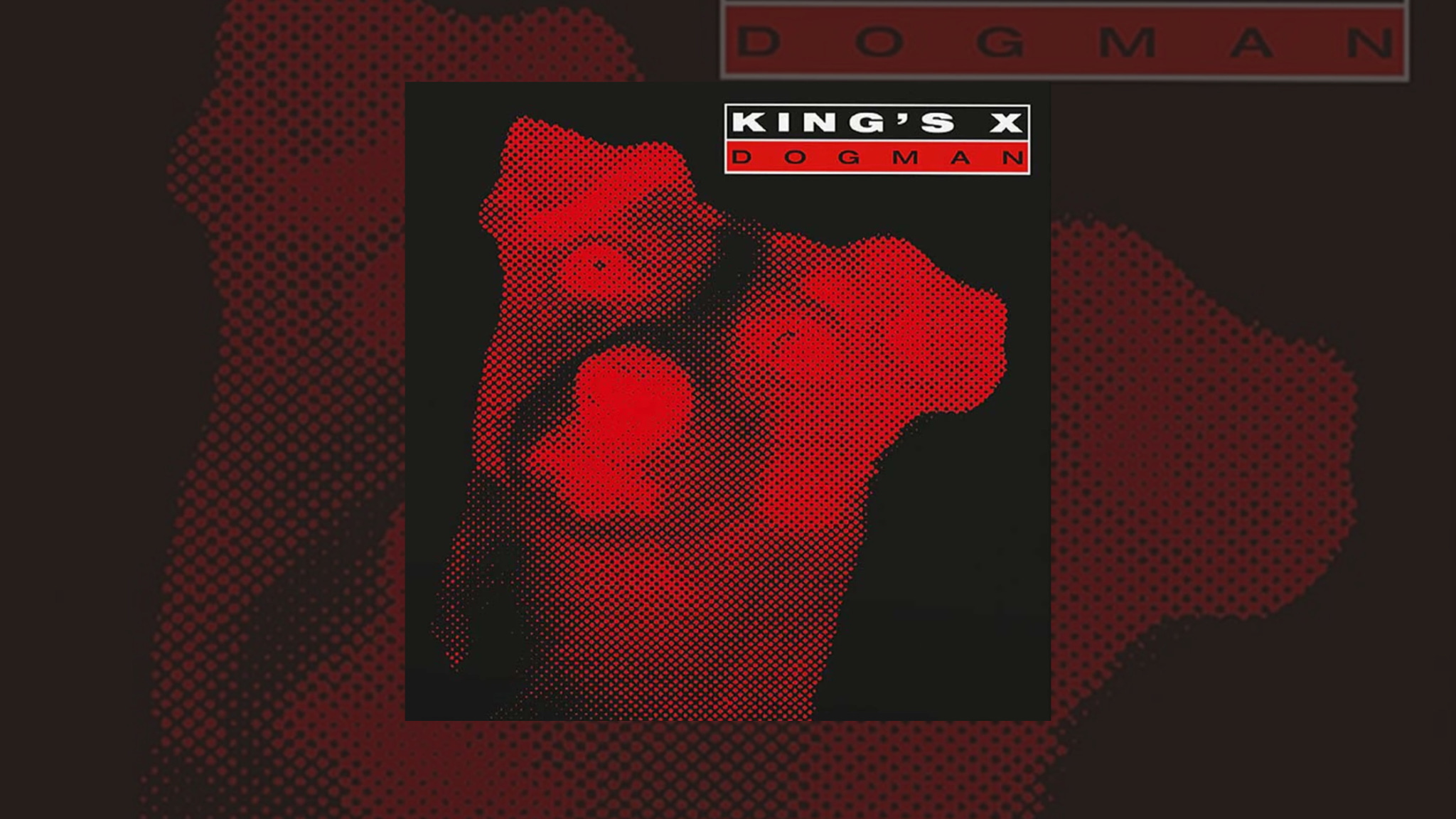
Produced by Brendan O’Brien (then fresh off Vs. with Pearl Jam), Dogman (1994) was a reset button for the band. The album was a raw, heavier offering that stripped away the polish of earlier records. “Brendan asked, ‘What do you want me to do?’ and I said, ‘Make us sound like we do live,’” Pinnick recalled.
Dogman wastes no time, with the title track launching thick, muscular riffs at the listener right from the first seconds. It effectively sets expectations for the rest of the album, too. Heavier tones, sharper edges, and a jackhammer of a rhythm section to be found ahead. The result was seismic. Songs like “Black the Sky” and “Shoes” hit with a physical weight rarely heard in 1990s rock. Pinnick tuned down even lower than before, his 12-string bass roaring through O’Brien’s analog mix.
The album’s aggression came from genuine frustration. “Our manager had ripped us off, and we were pissed,” Pinnick said, laughing. “That’s a pissed-off record.”
It worked. The record’s stripped-back harmonies and crushing low end inspired bands like Alice in Chains and Living Colour, marking King’s X early pioneers of groove metal before the term existed. Their use of drop-D tuning, syncopated rhythms, and saturated bass distortion injected an unprecedented sense of forward momentum into the hard rock of the time. Rather than relying on the thrash-era hallmarks of speed or technical excess, King’s X emphasized rhythm and density, a shift that helped catalyze the groove-centric heaviness that would soon dominate heavy music in the tail end of the 1990s. Pinnick’s vocal phrasing, floating above the wall of sound rather than fighting it, became a key reference point for countless vocalists navigating the line between aggression and soul.
Toned Up
For Pinnick, tone extends beyond gear into personality. He laughed at the idea of secrecy. “I used to hate when musicians wouldn’t tell people what gear they used.” In dUg’s opinion, it’s really not the gear that matters. “It’s technique and tone,” he says (emphasis mine). “After that, whatever you play through will work. Jerry’s played every drum kit, Ty’s played every amp, I’ve played through everything, and it still sounds like us.” His point is that technique and self-definition shape tone far more than equipment choices. As he said, “hone yourself in and then everything else will work.”

This mindset anchors King’s X’s sound. Pinnick’s musical DNA stretches back to gospel choirs and funk collectives. “My mom’s side of the family were analytical… my dad’s side were completely different,” he said, adding “I [recently learned] my aunt was perfect pitched and she’s been playing piano since she was three… I was singing harmonies when I was three.”
Those roots blend with a voracious appetite for 1970s rock experimentation. Pinnick cites Sly and the Family Stone, Black Sabbath, Led Zeppelin, and even The Cult as personal touchstones:
“Sly had a groove that nobody else had. Prince didn’t have it. James Brown didn’t have it. Tina didn’t have it. They all had a massive groove and they were funky as they could be. But Sly had this like, gospel rock hybrid kind of groove where everybody could play their part without stepping on each other. But it was so rhythmically cool that they all could do that together. It’s like you sit there and go, ‘I don’t know who to listen to because everybody is laying this thing down on each other and locked into it.’
And Black Sabbath Masters of Reality. I mean, dude, Dogman is directly from that record, you know? All the songs were stories about real life things, life lessons, you know, with wisdom in it. And the riffs were just fat. They weren’t low. They were just fat and big and very sparse. And that record really affected me in a lot of ways that I never really noticed either. I don’t sit down and say I want a song like that. But it’s like it’s in the back of my mind and it comes out in my fingers or the way I write songs.”
Songwriting Process: Twisting the Familiar
Pinnick’s approach to songwriting is deceptively simple. “We like to do subtle things that surprise you rather than just kind of be a prog band or a blues band,” he said. “We take things and twist them until they’re fun.”
That approach defined Three Sides of One (2022), the band’s first studio album in 14 years. Recorded during the pandemic, it merged their classic intensity with new perspective afforded by age and introspection. “We all brought songs in,” Pinnick said. “I brought the big, fat riffs, Jerry brought the Beatles-type stuff.” As for Ty? “‘All God’s Children’ is pretty brutal, Ty brought that,” dUg said with a laugh.
The album became one of the band’s most globally successful releases, landing top-10 and top-20 positions across U.S., U.K., and European charts. Tracks like “Let It Rain” and “All God’s Children” balance melancholy and hope, reflecting a band still evolving and unwilling to compromise. “It was like an experiment to sonically make every song fit the song,” dUg said.
If there’s one throughline in Pinnick’s worldview though, it’s movement. “It’s got to groove,” he said. “Even if it’s mathy, you have to know where the one is. That’s why Meshuggah works—you can dance to it even when the beat’s crazy.”
That philosophy defines the King’s X rhythm section. Gaskill’s elastic swing and Pinnick’s percussive bass team up to feel both big but danceable. Even their most complex passages have a kind of physical clarity where the listeners may not quite know the time signature but they feel the pulse. “I like to write songs that make you march,” Pinnick said.
The King’s Legacy
King’s X’s endurance is remarkable, but their true legacy is how profoundly they reshaped the sound of heavy music. Before alternative metal, groove metal, or djent became established in their own right, King’s X had already built the blueprint of drop-tuned riffs with harmonic density, bass-forward heaviness, elastic swing, and vocal stacks that soar above heavy instrumentation. Their fingerprints run through modern bands like Periphery, Karnivool, Tesseract, and the entire lineage of harmony-driven heavy rock. Even the grunge explosion that eclipsed them commercially owed a quiet debt to their approach.
Their heaviness came from feel, personality, and a deep belief in the power of tone. Pinnick still embodies that ethos. “I’ve got 30 songs sitting around,” he said. “Maybe I’ll give them to a young band that doesn’t write songs, let them have some fun.” He laughed, but the gesture revealed something important. After decades of shaping the very language of modern heaviness, he’s still looking forward, still creating, and still eager find the next generation of talent.
If King’s X remains timeless, it’s because they were ahead of their time. The genre lines bands push today (the blend of groove, melody, and experimentation) are paths King’s X carved decades ago. Heavy music as we know it sounds the way it does because they worked hard at refining their own sound.
Following a strong run of fall 2025 performances and the confirmation of new material, King’s X enter their next phase with momentum and it’s exciting to see where they head next.
NO LOGS NO LIES JUST NOISE
Noise Protocol is hosting a mini tour with Gatto Black and Brooklyn post-hardcore homies Dweller.
Come out and say hey, hear some sweet tunes, grab your copy of the Noise Protocol zine Privacy is Punk issue 1, and some sweet stickers courtesy of Fight for the Future.
We’ll be running food drives and collecting donations for harm reduction and privacy advocacy as well.